Does collagen count as protein?
"Supplementation with whey protein elicited greater increases in both acute and longer-term muscle protein synthesis than collagen peptide supplementation, which is suggestive that whey protein is a more effective supplement to support skeletal muscle retention in older women than collagen peptides."
— Oikawa et al., American Journal of Clinical Nutrition (2020)
Collagen is the most-marketed protein that is least useful for muscle. Here is the straight answer the supplement industry keeps fuzzy — with the science, and a calculator that strips it out of your real number.
See your true muscle-effective protein and the leucine you gave up vs whey.
Collagen vs whey, side by side
| Collagen | Whey | |
|---|---|---|
| Leucine (% of protein) | ~2.5% | ~10.5% |
| Tryptophan | None | Present |
| Complete protein? | No | Yes |
| DIAAS as sole protein | ≈ 0 (negligible) | > 1 (high) |
| Raises muscle protein synthesis? | No (Oikawa 2020) | Yes |
| Counts toward muscle-protein target? | No | Yes |
| Best used for | Skin, joints, hair | Building / keeping muscle |
DIAAS-adjusted yield
Collagen's DIAAS score is zero.
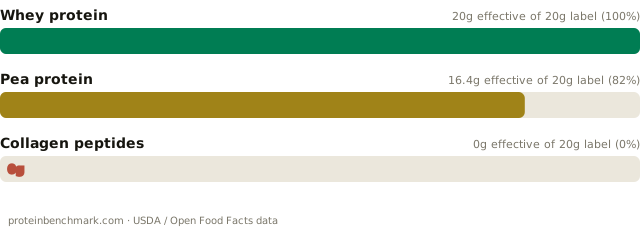
A 20g scoop of collagen peptides carries 20g of label protein — same as whey. Adjusted for digestibility and essential-amino-acid completeness (DIAAS), it yields 0g of muscle-protein-synthesis-effective protein, because collagen has zero tryptophan and cannot be scored against the FAO/WHO reference pattern at all. This is about MPS-effective grams specifically — not a claim that collagen is useless; see below.
| Source | Label protein (g) | DAY-effective protein (g) | Effective % |
|---|---|---|---|
| Whey protein | 20 | 20 | 100% |
| Pea protein | 20 | 16.4 | 82% |
| Collagen peptides | 20 | 0 | 0% |
DAY (Bioavailability-Adjusted Yield) = label protein × DIAAS, clamped at the label grams. Collagen's DIAAS is 0.00 because it lacks tryptophan entirely, so DAY = 0 regardless of serving size — this reflects muscle-protein-synthesis-effective grams, not the calories or the skin/joint evidence discussed above. See methodology.
Static image of this chart (for sharing)
Grams on the label vs grams your body can use
Same serving, two numbers. The tail is what digestion takes back — the reason a leucine-matched collagen scoop does nothing.
| Source | Label | Usable | DIAAS |
|---|---|---|---|
| Nutricost Whey Protein Isolate | 30 g | 30 g | 1.15 |
| Dymatize Elite Casein | 25 g | 25 g | 1.18 |
| Naked Nutrition Naked Whey | 25 g | 25 g | 1.07 |
| NOW Sports Soy Protein Isolate | 20 g | 18 g | 0.90 |
| NOW Sports Pea Protein | 24 g | 19.7 g | 0.82 |
| Vega Sport Premium Protein | 30 g | 24 g | 0.80 |
| Marketed as protein | 20 g | 0 g | 0.00 |
Why "high protein" on a collagen label is misleading
A collagen tub can legitimately say "20 g protein" because protein on a label is measured by nitrogen content — and collagen is nitrogen-rich. But that number says nothing about whether the amino acids are usable for the job most people buy protein for: building or defending muscle. Collagen is missing tryptophan outright and is extremely low in leucine, the amino acid that switches on muscle protein synthesis (see our leucine guide). Collagen has zero tryptophan and DIAAS ≈ 0; leucine-matched RCTs show it does not raise muscle protein synthesis (Oikawa 2020; Aussieker & van Loon 2023). Count its calories, not its grams toward the muscle-protein target.
This is the same anti-marketing logic behind our whole Protein Density model (% of calories from protein): the label number is not the truth. Collagen is simply the sharpest example — it can look elite by raw grams and still do almost nothing for muscle.
The honest "should I count it" rule
- Calories: yes. Collagen is ~4 kcal/g of real, absorbed amino acids. They count toward your energy intake.
- Muscle-protein grams: no. Do not include collagen in the protein number you are trying to hit for muscle. Subtract it.
- Skin / joints: separate goal. If you want collagen's skin or joint benefits, track it as its own supplement, not as protein.
GLP-1 users: this one matters most
On Ozempic, Wegovy, Zepbound or Mounjaro, a meaningful share of weight lost can be lean muscle without intervention, and appetite is suppressed — so every gram of protein has to work. Swapping in collagen "for protein" is a quiet trap: it does not preserve muscle, and it crowds out the complete protein that would. If you want the skin benefit during fast weight loss, take collagen in addition to, never instead of, your protein target. Our GLP-1 protein calculator gives you the real target collagen can't fill.
What collagen is good for
Being honest cuts both ways. Oral collagen has reasonable evidence for improving skin elasticity and hydration, and some evidence for joint comfort and tendon collagen synthesis. Typical effective dosing in the trials is roughly 2.5–15 g/day (10 g is common), taken with vitamin C (a cofactor for collagen synthesis), for 8–12 weeks before judging results. One caveat worth knowing: many positive skin studies are industry-funded, and the most recent meta-analysis found weaker effects among independently funded trials. Useful for skin and joints — just not a protein.
Put it to work
Strip collagen out and see your true muscle-effective protein.
The full head-to-head: amino acids, leucine, and what each is for.
The amino acid that separates real protein from label protein.
Exactly how we model collagen quality, with sources.
Frequently asked questions
Does collagen count as protein?
Not toward muscle. Collagen has zero tryptophan and a DIAAS of roughly 0 as a sole protein, so it is an incomplete protein that does not meaningfully drive muscle protein synthesis — even leucine-matched (Oikawa et al. 2020; Aussieker & van Loon 2023). Count its calories (~4 kcal/g), but do not count its grams toward your muscle-protein target. Food trackers that add collagen to your protein total are over-stating your usable protein.
Is collagen a complete protein?
No. Collagen lacks tryptophan entirely and is low in several other essential amino acids, so it does not meet the definition of a complete protein and its PDCAAS/DIAAS as a standalone protein is effectively zero.
Does collagen build muscle?
The randomized-trial evidence says no. Even when collagen was matched to whey for leucine, it did not increase muscle (myofibrillar) protein synthesis at rest or after exercise (Oikawa 2020; Aussieker & van Loon 2023, PMC10487367). Muscle requires a complete, high-leucine protein.
Does collagen count toward protein on a GLP-1 like Ozempic or Wegovy?
No. The reason GLP-1 users prioritise protein is to preserve lean mass during rapid weight loss — and collagen does not preserve muscle. It should not replace complete protein in your target. It may still help skin and joints as a separate goal.
So is collagen useless?
No — it just is not a muscle protein. Oral collagen has reasonable (often industry-funded) evidence for skin elasticity/hydration and joint comfort at roughly 2.5–15 g/day taken with vitamin C for 8–12 weeks. Buy it for skin and joints if you want those benefits, not as a protein supplement.
Sources
- Oikawa SY et al. 2020 (AJCN) — whey, but not collagen peptides, increased muscle protein synthesis in older women.
- Aussieker T, van Loon LJC et al. 2023 (PMC10487367) — collagen ingestion did not increase myofibrillar or muscle connective protein synthesis.
- Animal/plant/collagen amino-acid & DIAAS review — MDPI Nutrients 2020, 12(9):2670.
- Skin meta-analysis (PMC10180699) — collagen 2.5–15 g/day, ≥8 weeks; non-industry-funded studies show weaker effects.
- Shaw et al. 2017 (PMC5183725) — vitamin-C-enriched gelatin pre-exercise and collagen synthesis.
- Norton & Layman 2006; Witard et al. 2014 — leucine threshold for MPS (see the leucine guide).
Disclaimer
ProteinBenchmark is educational and not medical advice. If you're on medication (including GLP-1 agonists), pregnant, breastfeeding, have kidney disease, or any chronic condition, talk to a registered dietitian or your doctor before changing your protein intake or supplements.